ナミ
nami
波 — wave
Oda writes the character's name in katakana. The ordinary Japanese word nami means "wave" and can be written 波. Same sound. Different writing. The question is what, if anything, sits between them.
Oda's intention: unknown
There is a young woman in One Piece who has spent much of her life drawing maps.
If the name means nothing to you, One Piece is a Japanese manga created by Eiichirō Oda and first published in 1997. At its simplest, it follows a young pirate, Monkey D. Luffy, and the crew he gathers while travelling through an enormous imaginary world in search of the legendary treasure that gives the series its name. That description is accurate, although after almost thirty years of storytelling it is rather like describing the Odyssey as a book about a man trying to get home.
Among the first people to join Luffy's journey is a gifted young navigator and cartographer, extraordinarily good at reading weather and the conditions of the sea. Her own ambition has little to do with Luffy's treasure. One day, she wants to draw a map of the entire world from what she has seen with her own eyes.
Her name is Nami.
Or, more precisely:
ナミ
Oda writes her name in katakana, one of the two phonetic syllabaries used in Japanese. Katakana is familiar from foreign and loan words, onomatopoeia and various forms of graphic or phonetic emphasis; it can also be used for personal names, although Japanese names are more commonly written in kanji or, sometimes, hiragana.
There is a small complication hidden in those two syllables.
The ordinary Japanese word for "wave" is pronounced in exactly the same way — nami — but can be written with an entirely different character:
波
Nami is therefore not literally written "Wave". The connection appears first in the sound rather than on the page. A Japanese reader sees ナミ, the name of a person, while hearing nami, the same sound as the ordinary Japanese word for a wave.
I have not found a reliable explanation from Oda for the choice. There are plenty of theories, inevitably, but theories about an author's intentions are not evidence. Perhaps Nami simply sounded right for a navigator. Perhaps there was more to it.
We do not know.
Which leaves a rather good question.
Why call Wave a girl who dreams of drawing a map of the world?
I should also admit something before going any further. When I borrowed the same name for this project, I knew almost none of what follows. I liked Nami: the character, the sound of the name, the fact that she was the navigator. And, to be entirely honest, at the time I was also rather hopelessly in love with Emily Rudd, who plays her in Netflix's live-action adaptation.
Not exactly the most sophisticated of philological motivations.
Only later did I start wondering why the name seemed to fit so well with a project that, at least on the surface, had very little to do with the sea.
That question became a small research project of its own.
Pull at a word for long enough and it can take you surprisingly far.
Human beings were naming waves thousands of years before manga existed, and the words they chose do not all describe quite the same aspect of the phenomenon.
We can begin in the Mediterranean world of the Late Bronze Age and early Greek tradition. A warning is necessary. That world was culturally and historically remote from Japan, ancient or modern. I am not trying to invent a line of influence between Mycenaean Greece and contemporary Tokyo, still less a universal philosophy of the wave.
It is simply worth noticing what happened when languages separated by great distances tried to name the same physical event.
The ancient Greek κῦμα (kýma), "wave", belongs to the family of κύω (kýō): to swell, to become full, even to be pregnant. Behind it is a Proto-Indo-European root generally reconstructed as *kewH-, associated with swelling or pregnancy.
It is a remarkably bodily description. The surface becomes full; something rises from it.
Greek mythology offers an interesting parallel. In Hesiod's Theogony, Aphrodite emerges from the foam of the sea. The Greeks themselves traditionally associated her name with ἀφρός (aphrós), "foam", although modern linguistics does not regard that etymology as established.
There is no linguistic relationship between kýma and Aphrodite, and there is no reason to invent one. The connection is cultural rather than etymological: a word for the wave built around the idea of swelling, and a myth in which a goddess takes form from the foam of the sea.
Latin looks at the same phenomenon somewhat differently.
The Romans used unda, ancestor of Italian onda and French onde. Behind it lies an Indo-European family conventionally reconstructed around *wed- / *wod-, associated with water and wetness — the same broad linguistic territory that produced English water, Greek hýdōr and Russian voda.
With unda, attention shifts towards the substance itself: water.
Germanic and Slavic languages preserve still other aspects.
English wave developed from Germanic forms associated with movement and oscillation. German Welle is generally connected with the Indo-European *welH- / *wel-: to turn, roll or wind.
Russian волна́ (volná) and Czech vlna, descending from Proto-Slavic *vьlna, sit alongside Baltic forms such as Lithuanian vilnis in the same broad linguistic territory of rolling and undulating movement.
It would be foolish to reconstruct entire philosophies from etymology. Words tell us how languages developed, not what every person who spoke them believed.
But put these particular words next to one another and they make an unusually good physical description.
A surface swelling. Water. Oscillation. Rolling.
Different languages preserved different features of the same thing.
κῦμα · unda · wave · Welle · волна́swelling · water · movement · rolling
The Greek world offers another reason to look beneath the obvious surface of the sea.
In the modern popular version — call it the Disney-Little Mermaid version if you like — Poseidon easily becomes "the god of the sea": a trident-bearing aquatic ruler whose domain begins somewhere below the waterline.
That image is recognisable, but it leaves out much of what makes the Greek divinity interesting.
Poseidon is profoundly chthonic and telluric. Homer repeatedly calls him Ἐννοσίγαιος (Ennosigaios), the Earth-Shaker. The sea unquestionably belongs to his domain, but his power cannot be understood by looking only at its visible surface. He is also associated with the forces capable of disturbing the earth beneath it.
This aspect of Poseidon has occupied generations of scholars of Greek religion. It also brings me back to something I encountered many years ago in the work of the Milanese classicist Dario Del Corno, and which I would still like to trace precisely: Poseidon read not simply as sovereign of the visible sea, but as a divinity of deeper powers, capable of shaking the earth and throwing the sea into turmoil, raising storms and waves.
There is no need to pretend that the Greeks were describing modern geophysics. The important point is simpler: the same god who governs the sea is also the god who shakes the ground beneath the ordered world.
Modern physics, for entirely different reasons, makes the visible surface deceptive too.
Watch a wave approaching a beach and it looks as though a body of water is travelling towards you. In an ordinary surface wave, however, the individual particles of water largely oscillate around their positions. What propagates is primarily energy.
The wave is nevertheless perfectly real. It has height, wavelength, period, a front and a direction of propagation. At any given moment it has a measurable shape.
What it cannot do is keep that shape indefinitely.
As it approaches shallow water, its speed, wavelength and height change. The seabed modifies it. Rocks can deflect or divide it. The shape of a coastline affects the way it arrives. Eventually it may break and the particular geometry we were following disappears.
Yet until that happens, the front continues to advance and energy continues to propagate.
This is considerably more interesting to me than the familiar idea that "the wave symbolises change".
A wave can have a clear direction without having a final form.
A wave can have a clear direction without having a final form.
It can be concrete enough to produce consequences and plastic enough to adapt continuously to the conditions it encounters.
This is where Mircea Eliade becomes useful.
In Patterns in Comparative Religion he devoted substantial attention to water and aquatic symbolism across very different religious traditions.
For Eliade, water is not interesting merely because it changes. It comes before form. Immersion dissolves established forms; emergence allows new ones to appear. Water becomes a field of possibilities from which forms arise and into which they may disappear again.
His comparative method has been widely debated, particularly his tendency to look for shared structures across cultures that were historically very different. We do not need to accept the whole system to borrow one useful question from it: what does it mean for something to have a form without possessing it permanently?
A wave offers an almost literal answer.
For a while it has a crest, a front, a direction and a recognisable geometry. Then that geometry changes or disappears, while the water from which it emerged remains.
And by now a thread has begun to appear.
Greek kýma gave us swelling and emergence. Unda returned us to water. Welle and volná preserved rolling and movement. Poseidon moved our attention beneath the surface. Physics described a recognisable form carrying energy while continuously adapting to its surroundings. Eliade added the idea of form emerging from something that does not preserve form permanently.
These are not fragments of one theory.
But from very different directions they keep bringing us back to the same awkward object: something real and recognisable, with direction and consequences, whose identity does not depend on remaining geometrically unchanged.
With that in mind, we can return east. To 波.
The character 波 has a history much older than the Japanese use with which we began.
It originated in Chinese writing and, despite what its appearance might suggest to a modern eye, it is not simply an ancient drawing of a wave progressively stylised over time.
波 is phono-semantic.
On the left sits 氵, the water component derived from 水. On the right, 皮 historically supplied the phonetic element. Meaning and sound were assembled within the same written character.
In modern Mandarin, 波 is pronounced bō.
Japanese: nami
ナミ — Nami
When Chinese writing was adopted and adapted in Japan over many centuries, something particularly interesting happened. Japanese already possessed its own spoken word for the wave: nami.
The word was not simply borrowed from Chinese along with the character. An existing Japanese word came to be associated with an imported written sign.
That is why 波 can be read nami in Japanese.
A single character therefore carries overlapping histories: an indigenous Japanese word and a system of writing whose ancestry lies on the Asian continent.
Oda adds another layer.
His Nami is not written 波. She is ナミ.
He uses katakana and, in a sense, returns us to sound. On the page we see a girl's name; once pronounced, nami immediately reopens the ordinary Japanese word "wave", and behind it remains the semantic field of 波.
We do not know how much of this Oda intended.
But the history of the character already tells us something useful for what comes next: Japan was never a sealed cultural container. Even the written form of the word carries a history of importation, adaptation and recombination.
A native word and a foreign writing system learned to coexist.
A few centuries later, another Japanese wave would travel in the opposite direction and become recognisable almost everywhere.
Around 1830, Katsushika Hokusai began publishing Thirty-six Views of Mount Fuji. One print from that series has become perhaps the most recognisable Japanese artwork outside Japan: Kanagawa-oki nami ura.
Under the Wave off Kanagawa.
The Great Wave.
It has been reproduced so relentlessly — posters, mugs, T-shirts, advertising, tattoos — that seeing the original composition afresh requires a little effort.
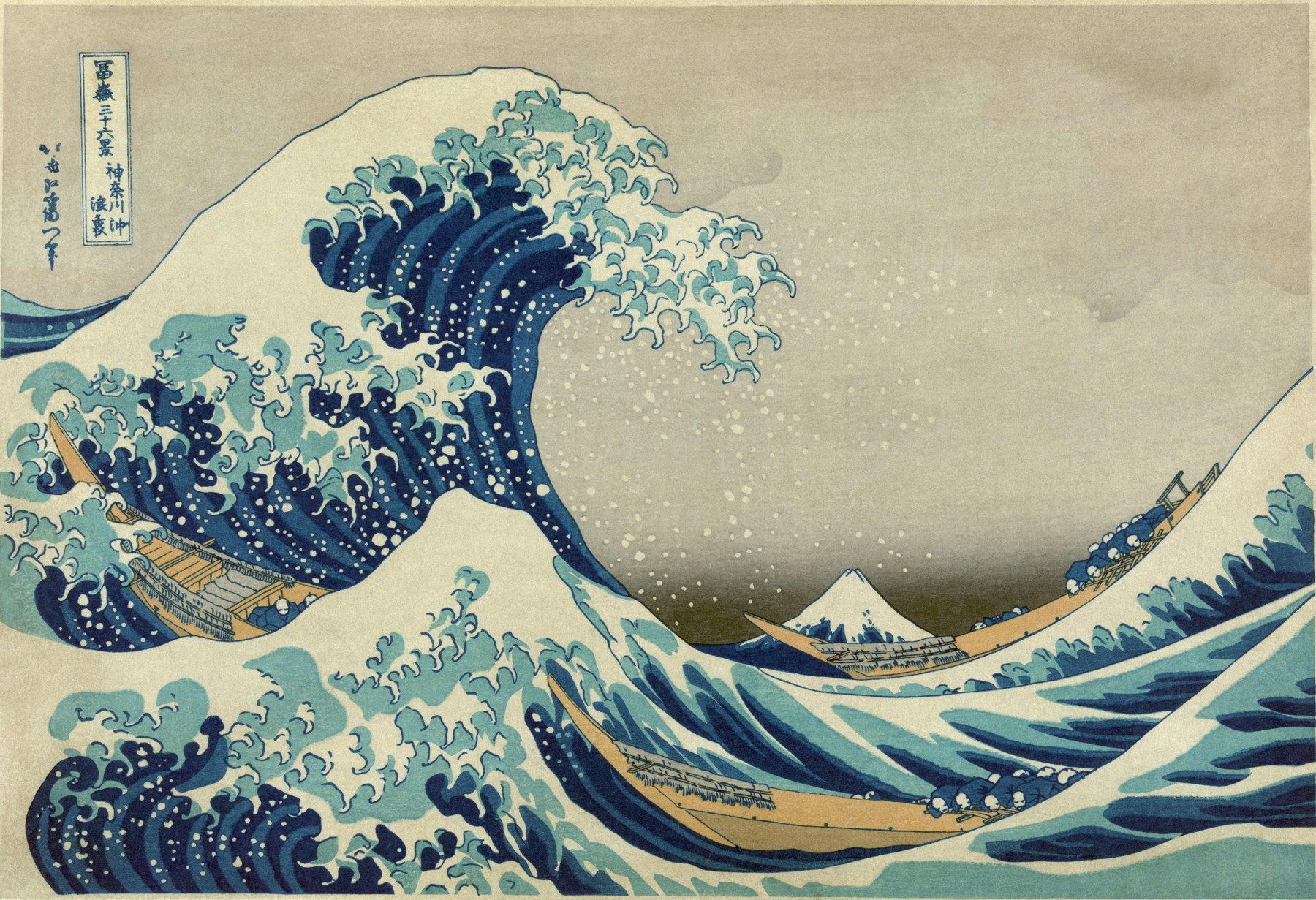 Katsushika Hokusai — Under the Wave off Kanagawa, c. 1830–32 · Thirty-six Views of Mount Fuji · The Metropolitan Museum of Art, public domain
The wave dominates the image.
Three narrow boats run beneath it. Far in the distance sits Mount Fuji, so small that its triangular outline can almost be mistaken for another wave.
Yet the series is not Thirty-six Views of the Sea.
Its subject is Mount Fuji.
Hokusai places something apparently stable and enduring in the distance while allowing a form that will cease to exist moments later to dominate the scene.
It is tempting to turn this into a ready-made lesson about permanence and impermanence. Hokusai does not need us to supply one.
The visual fact is already enough.
Fuji keeps its form. The wave does not.
That does not make the wave formless. Quite the opposite. At that instant it possesses an extraordinarily powerful shape. It has a front, direction and visible mass. It determines what the men beneath it are able to do.
A few seconds later it will be different.
For the moment it is entirely real.
And here much of what we have followed begins to appear in one image: the swelling of kýma, the water of unda, the rolling of Welle and volná, the temporary form that interested Eliade, and a physical object whose geometry depends on the forces and conditions acting upon it.
The men in the boats add one last element.
They cannot ask the wave to preserve the shape it had a minute earlier. They cannot impose the shape they would prefer. They have to deal with the one that is there.
At that point the wave begins to become a question of navigation.
More than a century and a half after Hokusai, Eiichirō Oda began drawing pirates.
One Piece did not appear fully formed. Oda had wanted to become a manga artist from an early age and worked for years on ideas that eventually entered the series. The two versions of Romance Dawn already contain parts of the future world, along with female characters such as Silk and Ann in whom some ingredients of the later Nami can be recognised.
When One Piece began serialization in 1997, however, her role was clear.
Nami is the navigator.
After everything we have followed, "navigator" begins to mean rather more than it did at the start.
Luffy can choose a destination. He can decide that he wants to reach an island, find the One Piece or sail across the world.
Wanting to arrive somewhere does not produce a route.
Someone has to understand what lies between departure and arrival.
That is Nami's work. She reads weather and currents, interprets changes in the sea, draws charts and alters the course when conditions demand it. She does not remove uncertainty from the world through which the crew travels. She understands enough of it to move through it.
Maps entered her life long before the Straw Hats did.
As a child she drew them obsessively. Her story then took a brutal turn. Arlong, leader of a pirate crew of fish-men who had violently seized control of the village where Nami grew up, recognised her extraordinary talent for cartography. After killing her adoptive mother, he forced Nami to work for him and draw the charts he needed.
What had begun as curiosity, talent and a childhood dream became part of her captivity.
When she finally escaped Arlong's control, she did not abandon cartography. She reclaimed it and kept the ambition she had held as a child: to draw a map of the entire world from what she had seen with her own eyes.
There is a contradiction here that I find difficult to ignore, whether Oda intended it or not.
A map tries to make the world stable enough to be represented.
A wave exists precisely because that stability does not last.
And the person who wants to draw the world is called Wave.
A good map, of course, does not require the territory to remain fixed forever.
It requires us to correct the map when we discover that the territory is not quite what we thought.
Dreams in One Piece tend to be unreasonable.
Luffy wants to find the legendary One Piece and become King of the Pirates. Zoro wants to become the greatest swordsman in the world. Sanji searches for the mythical All Blue. Nami wants to map an entire planet.
Oda takes these ambitions seriously without pretending that wanting something solves the practical problems of reaching it.
Ships break. Weather changes. Food runs out. Money matters. Bad decisions have consequences.
Between the dream and its fulfilment lies an enormous amount of ordinary, unheroic work.
Nami occupies an interesting position precisely because she connects those two scales. Her ambition is absurdly large; her daily work is stubbornly practical. She watches clouds, reads currents, draws charts, calculates courses, keeps an eye on money and frequently has to inject reality into a group otherwise quite capable of sailing enthusiastically towards disaster.
Her pragmatism is not the opposite of the dream.
Her pragmatism is what allows the dream to survive the journey.
And this, much more than the fact that One Piece happens at sea, is where the name began to make sense for something I was building on four wheels and mostly on dry land.
Because choosing a destination is not the difficult part.
The difficult part is working out what has to be learned, changed and adapted if you still want to move towards it once reality begins interfering with the plan.
Why does any of this matter?
Because Nami Dusty Life is itself an experiment in making room for curiosity, learning and play inside an adult life that is already full.
Read The Project →Nami Dusty Life did not begin as an escape plan.
Nor did it begin, initially, with Paris–Beijing. That came later.
At first there was a much less defined suspicion: that somewhere inside an adult life already full of work, relationships, children, routines and responsibilities, there should still be serious room for curiosity, play and learning things we do not yet know how to do.
Not because they are useful to a career. Not because somebody is paying us to learn them. Simply because we want to know.
The pickup became one way of testing that idea.
When I began, I knew very little about overlanding. I could have treated that as an inconvenience, learned quietly and begun writing only once I was competent enough to look convincing.
The opposite seemed more interesting.
Not knowing became part of the experiment.
Navigation led to mechanics. Mechanics led to vehicle recovery. Equipment led to questions about weight, reliability and what was actually necessary. Travel introduced borders, logistics, geography and history. Safety brought medicine and physiology into the conversation. The vehicle produced questions about technology, repairability and the wisdom of modifying something that already works.
And apparently borrowing the name of a manga navigator can lead to Proto-Indo-European linguistics, Poseidon, Mircea Eliade and Hokusai.
That is not a detour from Nami Dusty Life.
It is a small example of how the project works.
Start with something I do not understand particularly well. Ask a question. Discover that the answer produces another question. Allow the original idea to change when reality provides better information.
Paris–Beijing 2029 came later and gave all of this a direction. It is far enough away, difficult enough and slightly unreasonable enough to force me to learn things I would otherwise have very little reason to learn.
But direction is not the same thing as final form.
And this is where the wave we have been following finally belongs inside the project rather than beside it.
Greek kýma gave us swelling and emergence. Unda brought us back to water. Welle and volná preserved movement and rolling. Poseidon drew attention below the visible surface. Physics gave us a form that propagates energy while continuously responding to the medium through which it moves. Eliade asked what it means for something to acquire form without owning it permanently. Hokusai placed an immense temporary shape in front of something apparently permanent.
They do not form a single doctrine.
Oda does not need to have read any of them. He works in a modern Japan already shaped by centuries of exchange, adaptation and recombination. One Piece itself is exuberantly syncretic: pirates, European imagery, Asian traditions, mythology, modern popular culture and inventions entirely Oda's own coexist without needing to share a common origin.
I am therefore much less interested in claiming that the Greek wave somehow became Oda's Nami than in noticing how well the different layers can coexist.
Because the wave that emerges from them is not simply a symbol of change. It is more precise than that.
A wave has a front. It carries energy. It has a direction. At any given moment it possesses a real shape and produces real consequences.
But that shape has to negotiate continuously with what it encounters: depth, seabed, coast, rocks. Change the conditions and the geometry changes with them.
What it does not necessarily lose is the direction in which its energy is travelling.
That is much closer to Nami Dusty Life than "adventure" has ever been.
The idea behind the project is reasonably precise. I want to find out whether curiosity, learning, play and a deliberately unreasonable objective can occupy a serious place inside an adult life that is already full, without requiring an escape from that life.
The method is less certain because it has to survive contact with reality.
The vehicle may change. The route certainly will. What I believe is necessary will change as I learn more. What I need to learn will change as soon as I discover how much I do not know.
The project will have to adapt to work, people, time and whatever the road eventually puts in front of it.
That does not mean there is no project.
A direction without a predetermined shape.
And that brings us back to the girl with whom all of this began.
Nami does not decide what the sea will be like.
She watches it.
She understands enough of what it is doing to draw a route through it, and when conditions change, she corrects the map.
The destination does not disappear merely because the line required to reach it has changed.
When I chose her name, I had thought about almost none of this.
The reasons came later, one at a time, by following a question that initially seemed much simpler.
Now I know at least why the name stayed.
Nami.
A navigator called Wave, for a project whose direction I know but whose shape I do not.